


Products
Support
Contact Us
No. 509-510, Bldg B, Idea Industry Park, Fengxiang Road, Shunde District, Foshan, Guangdong, China
 +86 186 8025 3077
Mon - Fri (6:00 AM – 10:00 PM)
Sat - Sun (6:00 AM – 10:00 PM)
 darren@fsmanybest.com
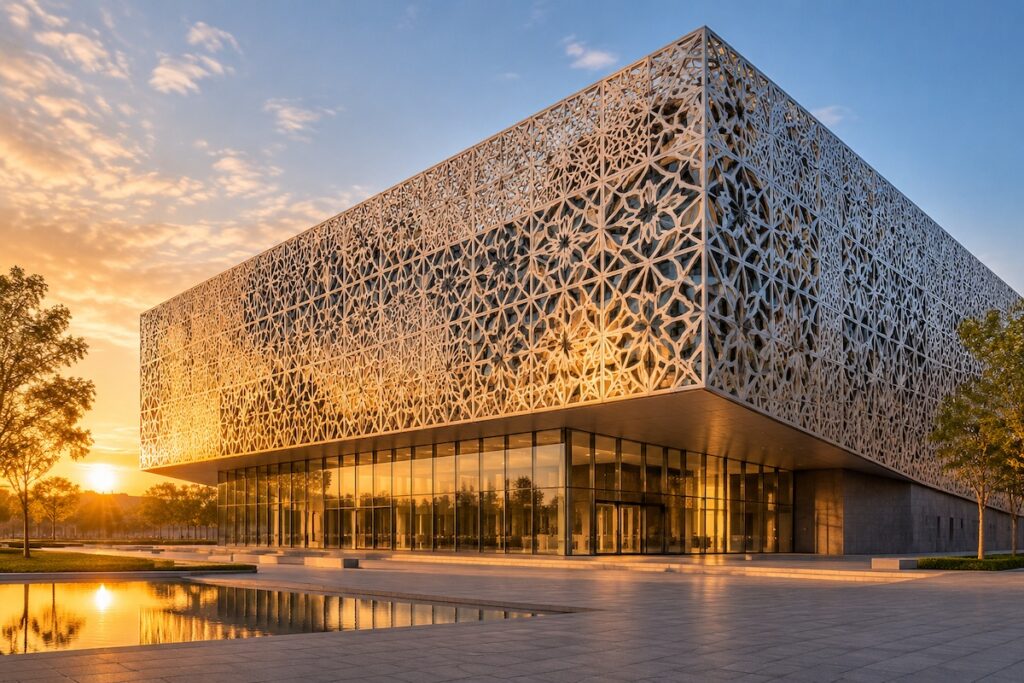
A building's facade is its face to the world. It is what people see first, remember longest, and judge most harshly.
Most facades are functional — weatherproofing, insulation, structure. But a facade can be more. It can be a statement of identity, a piece of public art, or a cultural signal. Decorative aluminum facade panels make this possible without sacrificing the performance that modern buildings require.
Here is how architects use decorative aluminum to transform ordinary facades into memorable landmarks.
Decorative aluminum facade panels are exterior cladding elements that combine weather protection with visual expression. They are engineered to:
| Function | How Decorative Aluminum Delivers |
|---|---|
| Weather protection | Aluminum face sheets resist UV, moisture, and temperature cycling |
| Structural integrity | Composite core provides rigidity; withstands wind loads |
| Visual identity | Custom perforation, relief, and finish create unique building appearance |
| Solar control | Perforated panels filter light, reduce heat gain, maintain views |
| Acoustic buffering | Perforated panels with backing absorb urban noise |
| Privacy screening | Variable perforation density controls sightlines without blocking light |
The most versatile decorative technique for facades. Perforations create visual depth, filter light, and control solar gain.
| Pattern Type | Visual Effect | Functional Benefit |
|---|---|---|
| Standard round holes | Clean, industrial aesthetic | Uniform light filtration |
| Variable density | Gradient from solid to open | Solar control transitions |
| Custom geometric | Brand logos, cultural motifs | Building identity |
| Organic patterns | Nature-inspired, flowing forms | Biophilic design |
Technical note: Perforation patterns are engineered for structural integrity. Hole size, spacing, and panel thickness are calculated to maintain wind-load performance.
CNC machining creates raised or recessed surface textures that catch light and cast shadows across the facade.
Precision laser cutting creates intricate patterns with tolerances of ±0.1mm. Ideal for:
| Finish | Appearance | Durability |
|---|---|---|
| Anodized | Metallic, iridescent | 25+ years, scratch-resistant |
| PVDF coating | Any color, matte or gloss | 20+ years, UV-stable |
| Brushed | Directional texture, metallic | 20+ years, hides scratches |
| Wood grain | Natural wood appearance | 15–20 years, requires PVDF topcoat |
| Metallic flake | Sparkling, reflective | 20+ years, high impact |
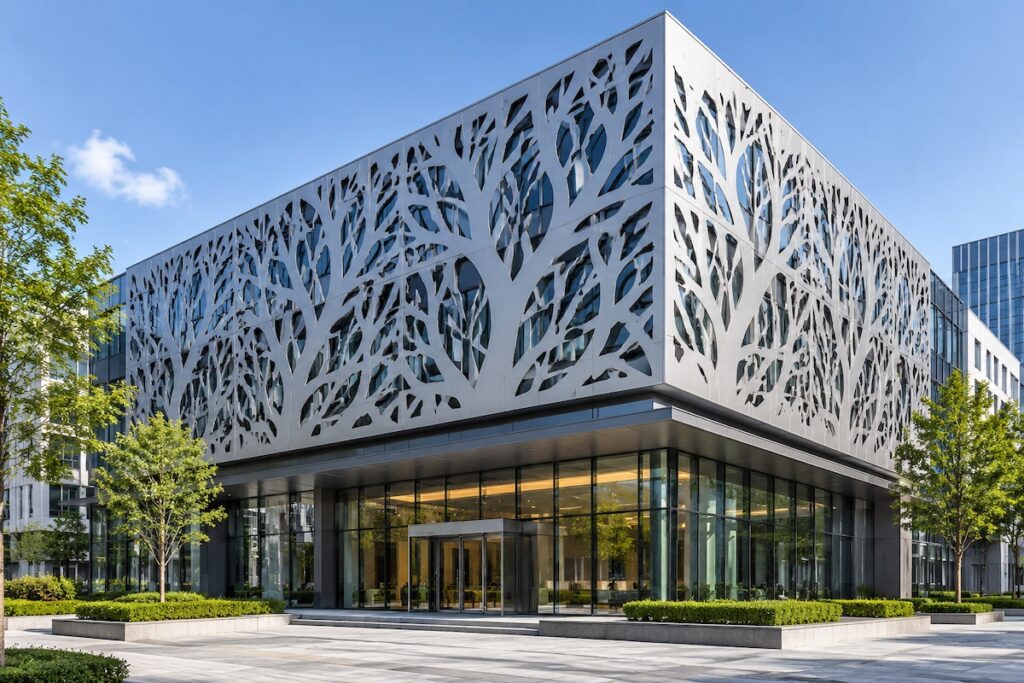
Decorative aluminum facade panels are not just aesthetic. They are engineered for structural and environmental performance.
| Parameter | Specification |
|---|---|
| Material | Aluminum alloy 3003, 5005, or 6061 |
| Thickness | 2.0–4.0mm (facade); 1.5–3.0mm (screen) |
| Panel size | Up to 1,500mm × 4,000mm |
| Core (composite) | Polyethylene, fire-retardant mineral, or aluminum honeycomb |
| Coating | PVDF (standard); anodize (premium) |
| Fire rating | A2 or B1 per EN 13501-1 |
| Wind load | Engineered to local codes; up to 5 kPa |
| Thermal performance | U-value 0.8–1.5 W/m²K (composite panels) |
Custom design engineering — From concept to fabrication drawings. We translate architectural vision into buildable panels.
Pattern library — 200+ standard perforation patterns; custom designs developed in 48 hours.
Prototype service — Full-size mock-ups for client approval before production commitment.
Fire-rated standard — A2/B1 classification with full documentation.
Coastal-grade finishes — PVDF as standard for any project within 5km of the ocean.
A facade is a building's most visible surface. It is also its most permanent — designed to last 30–50 years. Decorative aluminum facade panels ensure that those decades are visually compelling, not just functionally adequate.
[Request Facade Samples] | [Download Pattern Catalog] | [Get a Quote]
Manybest — Facades That Define Buildings.
Customized aluminum panels are very durable and will last a long time even with regular use. They can be used outdoors or indoors and will not rust or fade over time. This means that they will not need to be replaced as often as other materials like wood or plastic would need to be replaced.
Their appeal stems from the numerous advantages they offer over other materials. Some of these advantages include being lightweight, long-lasting, and low maintenance.
Aluminum Veneer System is a collection of internal and external cladding developed to fulfill the specific needs of each project. Special dimensions and designs can be requested by designers, architects, and consultants. These decorative panels are commonly employed in both commercial and residential buildings. It is used in industrial applications such as cladding, facades,and building products like windows, doors ,screen and ceiling.
Aluminum Panels is one of the most popular materials used in home construction and renovation. This element is lightweight and also has a high strength-to-density ratio, which makes it ideal for building homes and other structures.
If you are looking for an alternative to wood or vinyl siding, aluminum panels can be a great choice. Aluminum is easily customizeble, so you can find just about any color that you want. There are some things that you should know about this type of panel before you begin your project.
1)Special dimension and designs can be customized according to project requirements.
2)Could be customized for indoor/outdoor ceiling and wall decoration.
3)Relatively low maintenance solution for any wall application.
4)Windproof and waterproof, fireproof. Would not fade or rust or corrode, durable enough
for long term use.
5)You can enjoy one strop service from design to installation guide for your project from our team.
We have rigorous quality test system, from raw materials to finished products, the materials must be checked and signed by QC people.
And The finished product must go through three rounds of spot inspection.We must provide the best products to our customers.
For those regular customers, we offer incredible discount, sample free shipping, 3D Graph Draw, custom packaging and QC as per custom requirements.
From 2009 to 2025Manybest is with 16 years experience in this industry, we have served clients from more than 100 countries/areas, Manybest is well-known for its quality and Manybest team win clients’ trust by honesty and down to earth business style.